Blog / Auffenberg Mazda of O'Fallon

Mazda MX-5 Miata vs. MX-5 Miata RF Key Differences Explained

 MX-5 Miata RF

If you've been looking for a new sports car and have been interested in the Mazda MX-5 Miata, it's likely you've been trying to answer the question what are the Mazda MX-5 Miata vs. MX-5 Miata RF key differences?

Well, you’re in the right place, we’re going to explain it to you in plain language. Both are two-seat roadsters built around the same core philosophy - responsive handling, a lightweight feel, and a connection to the road. But one detail separates them and understanding it will help you choose the right one.

What Makes the MX-5 Miata the Classic Choice

The standard Mazda MX-5 Miata features a traditional soft-top convertible roof that folds down manually in seconds. It's the lighter of the two, and that weight advantage contributes directly to its nimble, balanced feel behind the wheel. If you want the most open-air experience possible, the soft top is hard to overlook.

The 2026 Mazda MX-5 Miata is well-suited for anyone who values simplicity and immediacy. When you want the wind in your hair, you pop the latch and the roof folds back. It doesn't get more easy than that. 

What Sets the MX-5 Miata RF Apart

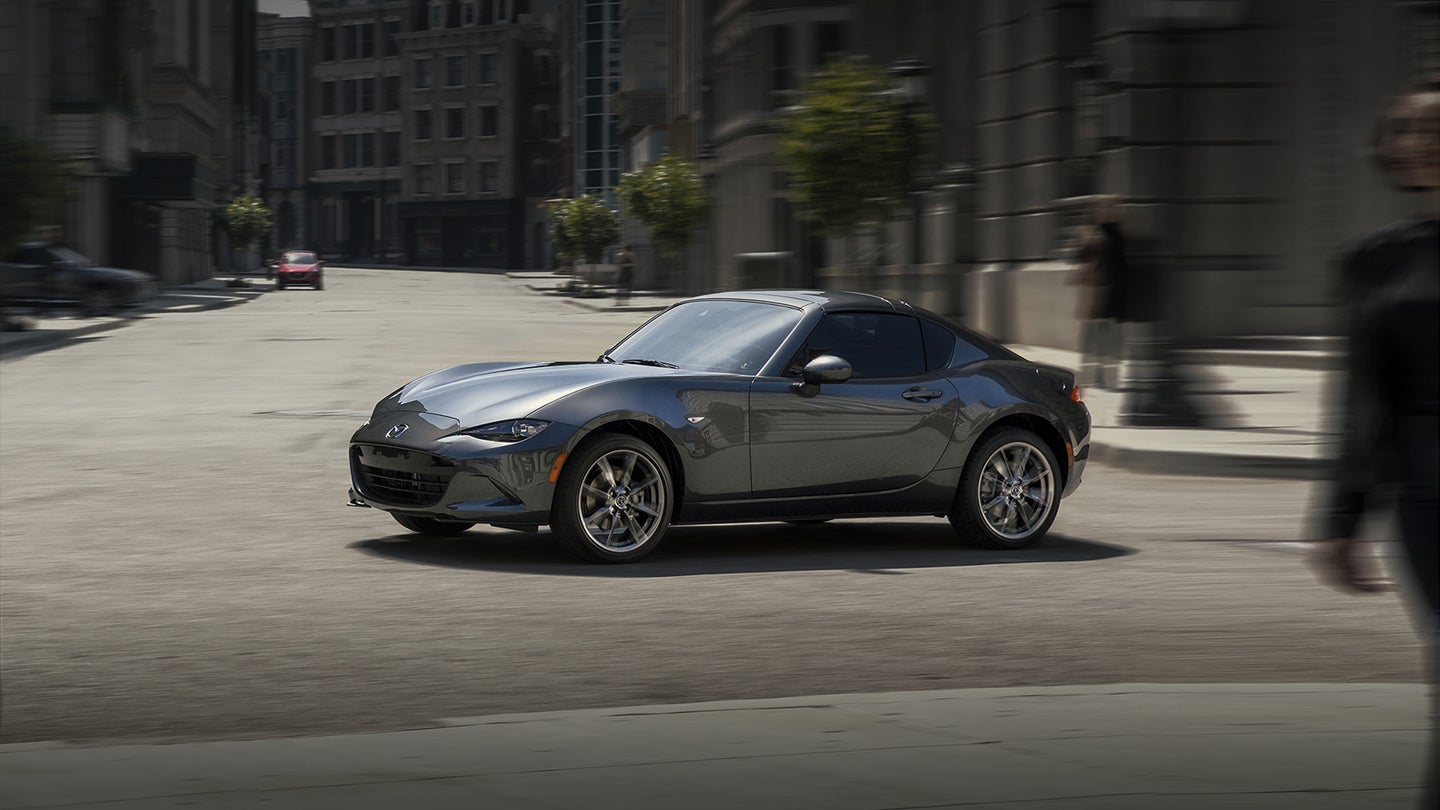
The Mazda MX-5 Miata RF  where RF stands for Retractable Fastback  features a power-folding hard top roof with a distinctive fastback roofline. When the roof is raised, it gives the car a more coupe-like appearance. When lowered, a portion of the roof remains in place, creating an open-air targa-style feel rather than a fully open convertible experience.

The RF's hard top offers better insulation from wind and road noise at highway speeds, which some drivers find more comfortable on longer trips. The trade-off is a small amount of added weight and a slightly less open feel compared to the soft-top version.

Performance: More Similar Than Different

When it comes to performance, the Mazda MX-5 and the MX-5 RF are closely matched. Both are powered by the same engine and deliver the same responsive, driver-focused character that has made the Miata a favorite for decades. Both also get 29 MPG combined based on EPA estimates, so gas milage is not a deciding factor between the two. 

What you'll notice more is the way the roof affects the overall feel of the car. The soft top feels more open and airy, while the RF delivers a more enclosed atmosphere when the roof is up.

Mazda MX-5 Miata vs. MX-5 Miata RF: Which Is Right for You

When looking at the Mazda MX-5 Miata and the MX-5 Miata RF side by side, it really comes down to personal preference. If you want a fully open convertible experience and a lighter overall feel, the standard MX-5 Miata is the clear choice. If you prefer a more polished look with a hard top and quieter highway manners, the RF makes a strong case for itself.

Visit Auffenberg Mazda of O'Fallon

So. if you're leaning toward the soft top or the Retractable Fastback, the team at Auffenberg Mazda of O'Fallon is ready to help you explore both options in person. Visit auffenbergmazda.com to browse current inventory, build your ideal MX-5, and schedule a test drive.


Posted in:

Related Posts

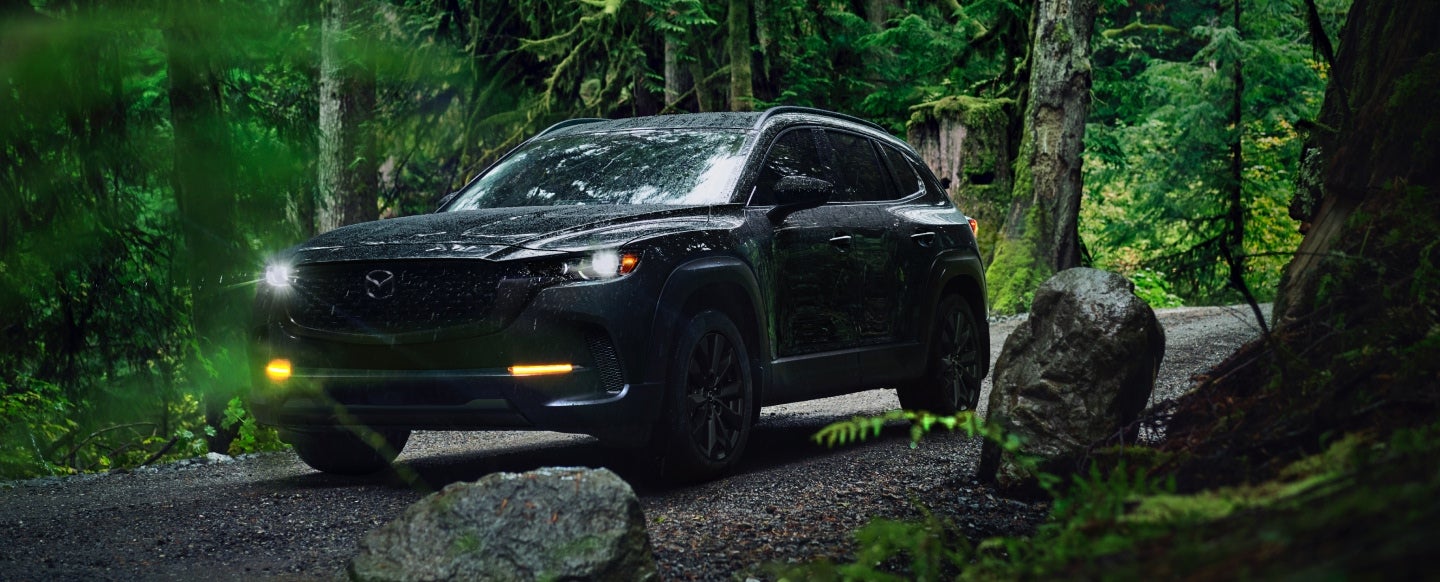
A black Mazda CX-50 driving along a gravel road through a lush, dense forest, with headlights on and large rocks and greenery in the foreground.

2026 Mazda CX-50 Towing: Enough Capacity to Make a Weekend More Interesting

The 2026 Mazda CX-50 sits comfortably in the crossover market. It's compact enough to live with easily, but properly equipped models can tow up to 3,500 lbs., opening the door to small campers, lightweight boats, and utility trailers. Add standard AWD and Mazda Intelligent Drive Select (Mi-Drive), and the CX-50 has a bit more versatility than its road-focused styling initially suggests. For drivers around Shiloh planning late-summer trips through Illinois: you can carry passengers and luggage comfortably, tow something useful behind you, and still have a crossover that feels in control. A 3,500 lb. Tow Rating Covers the Lighter End of Adventure Properly equipped, the CX-50 can tow up to 3,500 lbs. That's not heavy-duty territory, nor is it supposed to be. Instead, the capacity suits the sort of equipment crossover owners are more likely to use: compact campers, smaller boats, utility trailers, and recreational gear. Trailer weight still needs to be considered as a complete loaded figure, including equipment, supplies, water, and anything else added before departure. Staying within the ratings of the specific CX-50 configuration is important as well. Get those numbers right, and the Mazda's towing capacity can considerably expand what you're able to bring along for a weekend away. Turbo Torque Makes Sense When There's a Trailer Behind You Available Turbocharged CX-50 models use a 2.5L 4-cylinder producing up to 256 hp and 320 lbs. ft. of torque. The torque figure is the more interesting one when towing, as useful low- and mid-range response helps when pulling away with additional weight or maintaining speed over changing terrain. Standard AWD provides another useful element, distributing power across all 4 wheels when conditions require it. None of this turns the CX-50 into a truck, and Mazda hasn't tried to make it one. The advantage is having useful towing capability without giving up the dimensions and road manners that make a crossover appealing in the first place. Off-Road Mode Is for Getting Beyond the Pavement Mi-Drive gives the CX-50 selectable settings that alter vehicle behavior for different driving situations, including an Off-Road mode designed for loose or uneven surfaces. That's useful for Illinois trips where the final stretch to a campsite, trailhead, or recreation area may involve gravel or dirt rather than pavement. The system works with the CX-50's AWD hardware to manage traction and vehicle response for the conditions. It's best viewed as extra capability for getting to outdoor destinations rather than an invitation to seek out extreme trails. For most owners, a muddy campground or rough access road is a much more realistic test. The CX-50 Still Drives Like a Mazda Towing and rough-road capability are useful additions, but the CX-50 hasn't abandoned the road manners expected from a Mazda. G-Vectoring Control Plus works with the chassis to support predictable responses through corners, while the suspension balances control with the ability to deal with imperfect surfaces. That combination becomes useful on the rural and winding roads encountered during longer trips through central and southern Illinois. A crossover that can tow is more convincing if it remains pleasant to drive for the other 95 percent of the journey, and that's where the CX-50's chassis earns much of its appeal. Long Trips Need More Than a Tow Hitch Inside, the CX-50 combines supportive seating with a clean control layout and useful cargo space behind the rear seats. A 10.25-inch infotainment and available Bose® audio add convenience during longer highway stretches, while navigation and smartphone connectivity can handle the practical side of finding fuel, food, or the next campground. Cargo space is especially relevant when towing because not every piece of equipment belongs in the trailer. Bags, food, electronics, and smaller items can stay protected inside while the larger recreational equipment follows behind. Find the CX-50 That Fits Your Plans in Shiloh The Mazda CX-50 isn't trying to win a towing contest; but with up to 3,500 lbs. of towing capacity when properly equipped, standard AWD, available turbo power, and Mi-Drive capability, it's well suited to lighter recreational towing and late-summer travel. Visit Auffenberg Mazda of O’Fallon to explore available new CX-50 inventory, compare powertrains and trims, review towing equipment, and find the configuration that suits their trips. Then schedule a test drive online t o see exactly what we’re talking about.

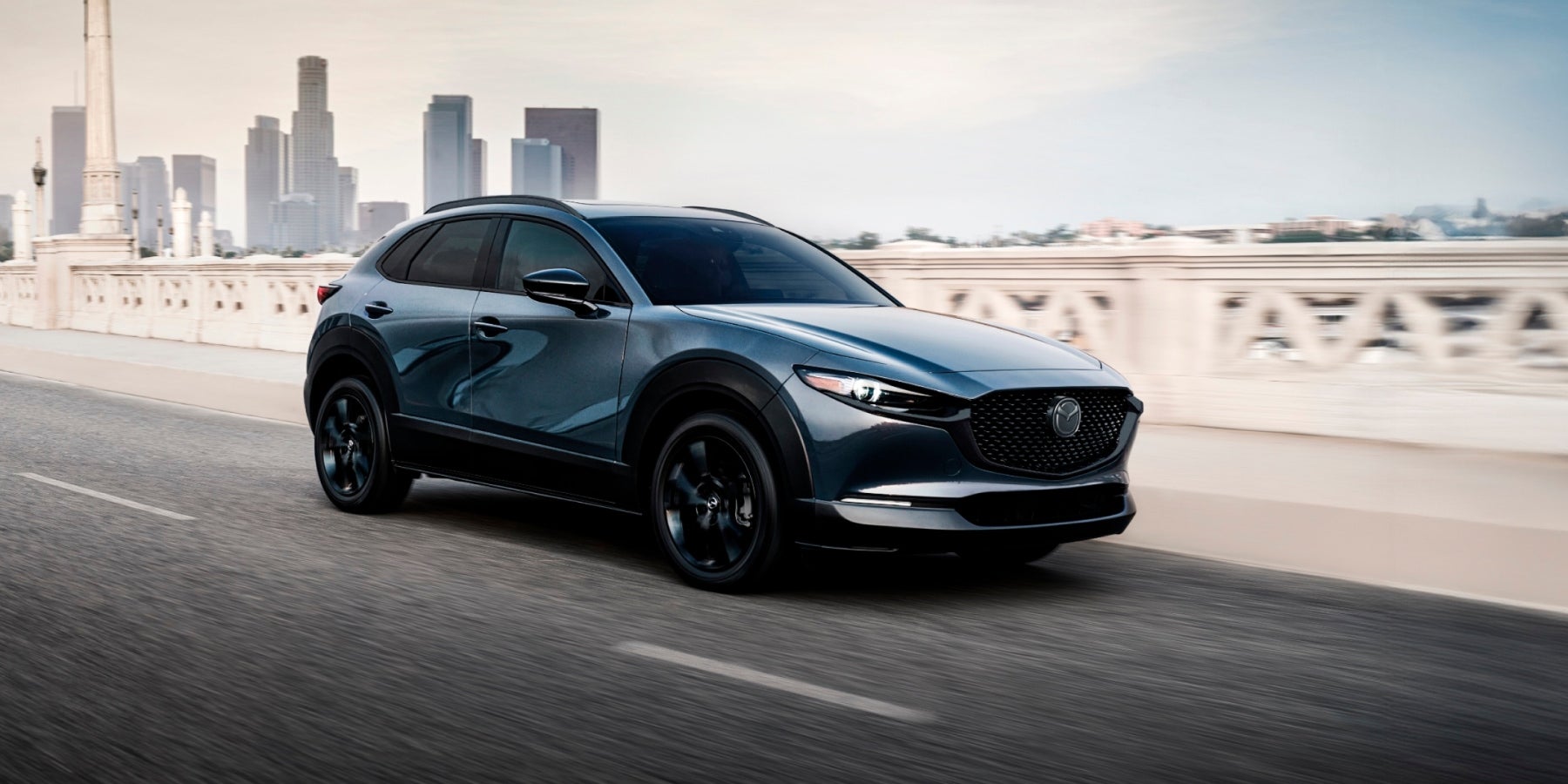
Dark blue CX-30 driving across a bridge with a city skyline in the background.

2026 Mazda CX-30 vs. CX-5: How Much Crossover Does Your Commute Need?

The 2026 Mazda CX-30 and redesigned 2026 Mazda CX-5 illust rate an increasingly rare idea: 2 crossovers from the same manufacturer that haven't been stretched into near-identical products. Both seat 5 passengers and come standard with i-ACTIV AWD®, but the CX-30 remains deliberately compact at 173 inches long, while the CX-5 grows to 184.6 inches and makes productive use of those extra 11.6 inches. For commuters around Shiloh, the decision comes down to a pleasantly straightforward question: do you value smaller dimensions and stronger available performance, or would you rather have more room? The CX-30 Is Small in Ways You Can Use Every Day At 173 inches long, the 2026 CX-30 takes up considerably less road and parking space than the CX-5. That's not an exciting specification until you're maneuvering through a cramped garage or trying to fit into the last sensible parking space. Its standard SKYACTIV®-G 2.5L 4-cylinder produces 186 hp and 186 lbs. ft. of torque, paired with a 6-speed automatic transmission. i-ACTIV AWD® and Off-road Traction Assist are standard, so buyers don't need to move through the trim range simply to get power sent to all 4 wheels. Fuel economy is EPA-estimated at 24 MPG city, 31 MPG highway, and 27 MPG combined. The Turbo Gives the Smaller Mazda the Bigger Punch CX-30 Turbo models provide a rather different experience. The SKYACTIV®-G 2.5L Dynamic Pressure Turbo produces up to 250 hp and 320 lbs. ft. of torque when using 93-octane premium fuel. That's substantial output for something this size and gives the CX-30 a performance advantage, the larger CX-5 doesn't attempt to match. Turbo models still return an EPA-estimated 22 MPG city and 30 MPG highway. The compromise comes in interior volume. Cargo capacity measures 20.2 cu. ft. behind the 2nd row and rear legroom is 36.3 inches, figures that make sense for a compact crossover but also explain why passengers and luggage may push some buyers toward the larger Mazda. The New CX-5 Spends Its Extra Inches Wisely The third-generation 2026 CX-5 st retches to 184.6 inches long on a 110-inch wheelbase, and Mazda has used the larger dimensions to improve passenger accommodation. Its SKYACTIV®-G 2.5L 4-cylinder produces 187 hp and 186 lbs. ft. of torque through a 6-speed automatic transmission. Standard i-ACTIV AWD® is joined by Mazda Intelligent Drive Select with Normal, Sport, and Off-Road modes. EPA-estimated combined fuel economy is 26 MPG, only 1 MPG behind the naturally aspirated CX-30. So, the CX-5 asks for more space in your garage, but surprisingly little at the fuel pump. The CX-5's Best Upgrade May Be the Back Seat Extra size is useful only if passengers benefit from it, and the redesigned CX-5 improves rear-seat legroom, knee room, and headroom. Wider-opening rear doors should also make loading passengers and bulky items easier. The 2nd row uses a reclining 40/20/40-split arrangement with a center pass-through, providing more flexibility when people and longer cargo need to travel together. That's an important distinction between these 2 Mazda’s. The CX-30 works well when the rear seats are used occasionally; the CX-5 makes a stronger argument for commuters who regularly carry adults, children, luggage, or equipment. The Technology Difference Is Becoming More Obvious The CX-5 also takes a significant step forward in display technology. CX-5 2.5 S models receive a 12.9-inch touchscreen with Google built-in, while upper trims offer a 15.6-inch display. A 10.25-inch digital instrument display is standard. Both vehicles offer Mazda's i-ACTIVSENSE® driver-assistance technology, with equipment depending on model and trim. Features include Mazda Radar Cruise Control with Stop & Go, Blind Spot Monitoring, Rear Cross Traffic Alert, Smart Brake Support, and Lane Departure Warning. Pick the Mazda That Solves Your Everyday Problem Choose the CX-30 if 173-inch dimensions, up to 31 MPG highway, and the option of 250 hp sound more useful than additional cabin volume. Choose the CX-5 if your commute regularly includes passengers or cargo and its larger interior and updated technology will earn their keep. Shiloh and St. Louis-area drivers can visit Auffenberg Mazda of O'Fallon to compare available new CX-30 and CX-5 inventory, explore trims, and see how differently these 2 crossovers use their space. Then schedule a test drive online and se e them for yourself behind the wheel.

A man smiling in a car while speaking with a salesperson while trading a car.

Your Trade-In Is Worth What the Market Says. Here’s How to Help It Say More

Trading in a vehicle shouldn't feel like preparing it for a beauty pageant. You don't need to make an older car look brand new. You do want to present a complete, well-cared-for vehicle and understand what affects its value before an appraisal begins. For drivers considering their trade-in value around Shiloh, IL, August can be a useful time to explore the numbers. New model-year inventory is changing, used vehicles remain an important part of dealership inventory, and your current car may represent meaningful equity toward your next Mazda. Start by Finding Out What Your Car Is Worth Before deciding what to buy next, establish a realistic value for the vehicle you already own. Mileage, age, trim, equipment, overall condition, vehicle history, and current demand can all influence a trade-in appraisal. Two cars from the same model year with similar mileage can receive different offers because they've lived very different lives. An online trade-in valuation tool can provide a useful starting point before visiting the dealership. If you're searching for a KBB® Instant Cash Offer near St. Louis, completing an online appraisal can give you a clearer idea of your vehicle's current market position. From there, an in-person inspection can account for its specific condition and equipment. Clean Is Good. Trying to Hide Problems Isn't You don't need professional detailing before every appraisal, but arriving with a reasonably clean vehicle makes the evaluation easier. Clear out personal belongings, vacuum the interior, remove unnecessary clutter from the cargo area, and wash the exterior. Make sure items belonging with the vehicle are present, including extra keys or accessories you intend to include. Service records can also be useful. They won't erase mileage or repair body damage, but a documented maintenance history can provide a clearer picture of how the vehicle has been cared for. Be straightforward about known damage or mechanical issues. An appraiser is going to inspect the car anyway, and an accurate description makes the process considerably simpler. Think Before Spending Money on Last-Minute Repairs This is where trade-in preparation can become counterproductive. Replacing an inexpensive burned-out bulb is one thing. Spending hundreds or thousands of dollars repairing cosmetic damage immediately before trading the vehicle is another. You aren't guaranteed to recover that expense through a higher appraisal. Before paying for a significant repair solely to improve trade-in value, find out how the existing problem affects the offer. In some cases, trading the vehicle as-is may leave you in a better financial position. If your car already needs routine maintenance you're planning to complete regardless, our service department can help. But don't assume every imperfection needs correcting before an appraisal. Keep the Trade and the New Mazda in Separate Columns Your trade-in value and the deal on your next vehicle are related, but they're easier to understand when you evaluate them separately. First, know what you're receiving for your current vehicle. Then look at the purchase or financing terms for the new one. This makes it easier to understand where your money is going instead of judging the entire transaction by a monthly payment. If you still owe money on your current vehicle, compare the loan payoff amount with its trade-in value. A vehicle worth more than the remaining balance has positive equity that can potentially be applied toward the next purchase. If the payoff exceeds its value, you'll want to understand how that difference affects the new financing arrangement. Our finance center can help explain those numbers before you make a decision. Your Trade Can Open Up More of the Mazda Lineup Once you know how much equity you're working with, shopping for the next vehicle becomes considerably easier. You might use your trade toward a new Mazda CX-5 or another crossover from our new Mazda inventory. Drivers interested in electrification can compare Mazda hybrid and plug-in hybrid models, while someone looking for something considerably less sensible and considerably more entertaining can explore the Mazda MX-5 Miata. You can also compare new and pre-owned Mazda inventory if maximizing the purchasing power of your trade is the priority. The useful question isn't simply, "How much can I get for my car?" It's, "What does that value allow me to do next?" Put a Number on Your Trade Before You Pick the Next Car Start with our online trade-in tools at Auffenberg Mazda of O'Fallon, serving Shiloh and the St. Louis Metro East, then browse our new Mazda inventory to see where your current vehicle's equity could take you. Once you've narrowed down your next Mazda, schedule a test drive online and compare the complete numbers before making the move.